Export Controls State of Play — April 2026

Iran, Enforcement, and Strategic Uncertainty
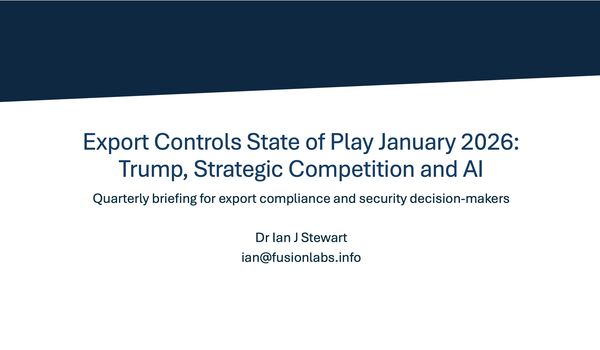
Export controls remain at the centre of international security and economic policy. Over the past three months, developments in the United States, China, and the Middle East have underscored how export controls are being shaped not only by technological competition, but also by active conflict dynamics and shifting geopolitical priorities.
This second edition of the Export Controls State of Play continues a quarterly series designed to help export compliance professionals, security decision-makers, and policy practitioners interpret these developments.
Rather than cataloguing every regulatory change, the focus is on prioritisation and interpretation: what has changed, why it matters, and how export controls are being used in practice in an increasingly volatile strategic environment.
What this briefing covers
The April 2026 edition focuses on five core themes.
First, it examines the impact of the U.S.–Iran conflict on the export control landscape. While export controls have not been the primary tool in the conflict itself, the reimposition of UN sanctions and the role of UAVs and missile technologies highlight the continued relevance—and limitations—of trade controls in constraining military capability.
Second, it assesses the evolving U.S.–China dynamic. The postponement of the Trump–Xi summit and ongoing discussions around a potential trade deal introduce uncertainty into the future direction of export controls, particularly in relation to advanced semiconductors, compute capacity, and critical minerals.
Third, it reviews key policy and legislative developments, including the introduction of the MATCH Act in the United States. This reflects continued efforts to align export controls across allied countries, even as multilateral regimes remain constrained.
Fourth, it highlights recent enforcement activity, with a particular focus on diversion risks involving advanced computing technologies. Cases involving alleged GPU diversion and the Applied Materials settlement illustrate how enforcement continues to provide insight into regulatory priorities, even where broader policy direction remains uncertain.
Finally, the briefing looks ahead to the coming quarter, identifying areas where geopolitical developments—particularly in relation to Iran and China—may drive changes in export control policy.
Enforcement, diversion, and the reality of controls
A central theme in this edition is the role of enforcement in shaping the practical application of export controls.
Recent cases point to a sustained focus on preventing the diversion of advanced computing technologies to China. These cases highlight the continued importance of intermediary networks, transshipment risks, and insider involvement in enabling diversion.
At the same time, the Applied Materials case provides a more technical illustration of how U.S. export controls are applied extraterritorially. The case underscores the importance of correctly determining whether items are subject to the EAR, and the risks associated with misapplying concepts such as “substantial transformation” or de minimis treatment.
Together, these developments reinforce a broader point: even where policy signals suggest potential relaxation or uncertainty, enforcement activity remains consistent and strategically targeted.
Conflict, technology, and the limits of export controls
The conflict with Iran also highlights the limits of export controls as a policy tool.
Despite decades of sanctions and trade restrictions, Iran has demonstrated the ability to develop and deploy effective asymmetric capabilities, particularly in the domains of UAVs and missiles. This raises broader questions about the effectiveness of export controls in constraining certain types of military capability, especially where technologies are widely available or adaptable.
At the same time, the increasing role of AI and advanced computing in military systems points to a growing overlap between export controls, sanctions, and other policy tools such as investment screening and research security.
Upcoming webinar: U.S. semiconductor export controls
For those looking to explore one of the most consequential areas in more depth, I will be delivering a live webinar with the Export Compliance Training Institute (ECTI) on 28 May 2026:
U.S. Semiconductor Export Controls: What Compliance Teams Need to Know
The session will examine recent changes affecting advanced semiconductors, manufacturing equipment, customer screening, licensing, and supply-chain risk—focusing on what has genuinely changed, what remains stable, and where companies face the greatest compliance challenges.
You can register here:
https://hubs.ly/Q049VB2y0
Who this briefing is for
This series is intended for:
- Export compliance officers and legal teams in industry
- Government officials involved in export control and sanctions policy
- Security and risk professionals assessing technology exposure
- Analysts and researchers working on international security and strategic competition
It is written to support internal briefings, compliance discussions, and strategic planning, rather than to serve as a technical licensing manual.
About this series
The Export Controls State of Play is produced on a quarterly basis by Dr Ian J Stewart, based on ongoing research into export controls, sanctions, and research security.
This edition is being made available openly. Future quarterly editions—including expanded analysis, case studies, and additional content—will be available to subscribers.
Subscribers will receive:
- Each quarterly briefing deck
- Accompanying written analysis
- Enhanced video briefings
- Notifications of significant developments between editions
Access the briefing
You can view or download the April 2026 Export Controls State of Play briefing below.
To receive future editions and additional analysis, you can subscribe via this site.